Oxeye Sunflower

Family:  Asteraceae

Scientific Name: Heliopsis helianthoides

A native perennial in Minnesota, most often found in full sunlight and dry to moderate soil conditions in prairies, roadsides, edges of fields and open woods.  It is a vigorously growing plant, and considered a weed by some.

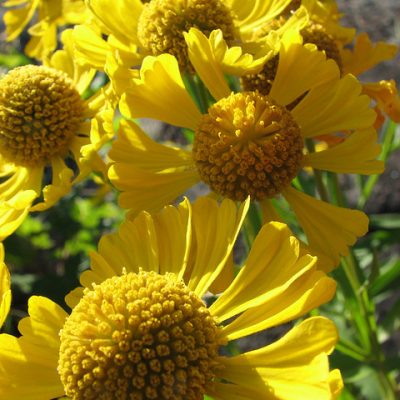
Watch for: Opposite leaves with coarsely serrated margins with leaf blades that vary in shape from oval to lance-shaped.  The stem is smooth and flowers have an orange-yellow center disk with yellow ray flowers.  The plant grows to about 3-4′ tall.

Other names: Early sunflower, Smooth oxeye, False sunflower, Oxeye daisy

History: Heliopsis comes from the Greek word helios, for “sun,” and opsis, for “appearance.”  In the past, the Oxeye sunflower was used in folk medicine to cure fevers and malaria.

Tidbits: The Oxeye sunflower starts blooming in July or August and continues for up to two months.  It is one of the earliest blooming sunflowers.  Heliopsis helianthoides provides food for songbirds throughout the winter and its nectar serves as a food source for ground nesting bees, as well as butterflies and hummingbirds.

Gardens/Cultivation: Oxeye sunflower is one of the best hardy plants for a wildflower or raingarden border.  It will survive in dry locations with little nutrients and in full sun to partial shade.  It will establish easily from seed when planted in the late fall or early spring.  The plant will grow in clumps of 2-4′ in diameter and they should be divided in the fall for best results.

__________________________________________________

 Sources: 

USDA Plants Database: http://plants.usda.gov

The University of Texas at Austin.  Native Plant Database.  http://www.wildflower.org/plants


The History of Lake Nokomis

This past Tuesday, myself, Mark Pedelty (a professor at the U of MN), and three of his students had the pleasure of learning about the history of Lake Nokomis from Steffanie Musich, President of Friends of Lake Nokomis, and Julia Vanatta with Wild Ones.  I learned more about Lake Nokomis that day than I thought there was to know, and I was intrigued so I went looking for even more information.  I have to say, Lake Nokomis has a long and colorful history.  If you’ve ever wondered just how and when it came to be (that’s right, it hasn’t always been a lake fit for swimming) read on and find out!

Lake Nokomis, known as Lake Amelia until 1910, was originally meant to serve as a reservoir to maintain the constant flow of water over Minnehaha Falls.  The park board did not actually own the land around Lake Nokomis, Rice Lake (Lake Hiawatha), or Minnehaha Creek in the late 1800s but that didn’t stop them from making plans to deepen channels and dam the lake.  Luckily, most of these plans fell through for reasons unknown today, but they were all made with the hope of maintaining a flow of water over the falls.  In fact,  in 1900 President Benjamin Harrison was quoted at the falls saying “Minnehaha Falls would undoubtedly be very beautiful if there was water in the stream.”

Read more »

Raingardens and Beyond Workshops, Soon to be at a Community Center Near You!

Schnazy new title, and some new information too.  This year Metro Blooms’ classic Raingarden Workshops are doing just what the new title says…they’re going beyond the do-it-yourself approach to raingarden design and installation and covering topics such as simple healthy lawn care practices more in depth.  The information you’ll gain will be oh so helpful not only if you plan to install a raingarden this summer, but also if you just want to know how to take better care of the lake down the road by taking better care of your yard.

Read more »

Lake Nokomis Water Quality Survey

Nokomis subwatershedMetro Blooms has recently taken on its largest survey yet.  Throughout February we’ve been prepping, administering and entering oodles of data from our first ever KAP study  (KAP stands for knowledge, attitudes and practices).  The idea behind a KAP study is to survey a population, in this case 700 residents in the Lake Nokomis subwatershed, before AND after a project to determine changes in people’s views and behaviors over time.

Read more »

It’s in the dirt! Bacteria in soil may make us happier, smarter

This post was written by Naomi Sachs, a landscape designer and Founding Director of the Therapeutic Landscapes Network.   

Many people talk about the restorative benefits of gardening and the reasons why it makes us feel good.  Just being in nature is already therapeutic, but actively connecting with nature through gardening is value-added.  And why is that? All sorts of reasons have been posited: It’s a meditative practice; it’s gentle exercise; it’s fun; it allows us to be nurturing and to connect with life on a fundamental level.

And some recent research has added another missing piece to the puzzle: It’s in the dirt. Or to be a little more specific, a strain of bacterium in soil, Mycobacterium vaccae, has been found to trigger the release of seratonin, which in turn elevates mood and decreases anxiety. And on top of that, this little bacterium has been found to improve cognitive function and possibly even treat cancer and other diseases. Which means that contact with soil, through gardening or other means, is beneficial.  How did this discovery come about?

Read more »

Biography of the Month

Bryan PynnTo kick off a new year of staff, board and volunteer biographies (that’s right volunteers, I’m coming for you next) I interviewed Bryan Pynn, Metro Blooms’ director of design and planning services.  He wasn’t super keen on the idea of having his life chronicled on our blog at first, but after some time spent reviewing pictures of past trips, I think he really warmed up to the process.  Bryan has been with Metro Blooms since 2009 when he, and half of the landscape design class of 2010, was hired as a landscape design assistant.  But I’m getting too far ahead.  What I really want to tell you about is how Bryan met the pandas, learned some Mandarin, ALMOST became a policy expert and hung with Steve, the coolest herpetologist in Nicaragua. Read more »

End of the Year Update

As the end of 2012 approaches Metro Blooms is looking back on some of the big moments we had this year.  As always we started the year out with a series of Blooming Schoolyardsraingarden workshops throughout the metro area and Blooms Day, an educational event combined with a plant sale and garden awards.  Our Blooming Schoolyards program really took off this year as over 220 elementary students were educated on landforms, water infiltration and raingarden site selection and design.  Some students even got to plant their own garden!

This summer you supported our garden party at Gleason Lake and this past fall Metro Blooms hosted our first stand-alone Garden Awards event at the Garden party at the Terlizzi residenceColombia Manor in Minneapolis which was attended by over 200 Metro Blooms supporters.  Finally, in December, we all got to celebrate the year at the Rock for Raingardens fundraiser at the Fine Line Cafe. Read more »

Rock for Raingardens Re-Cap

Last Wednesday Metro Blooms’ Rock for Raingardens event took place at the PostinaFine Line Cafe in downtown Minneapolis.  Metro Blooms board members and staff, friends of the bands, landscape design assistants and Metro Blooms supporters were all in attendance as Hypoxic Punks, Wild Cathedral and Postina entertained us with their upbeat and dance worthy music (and dance we did, which Barb made sure of).

The event doubles as a fundraiser for Metro Blooms and a recognition event for the landscape design assistants that Metro Blooms hires during raingarden workshop season.   Design assistants in attendance were given the honor of receiving an “award” from Metro Blooms’ landscape architect Bryan Pynn.  Examples of these highly descriptive awards include the “Scooby Doo” award and the “Foreigner” award.  Confused?  You’ll have to join us next year as we’ll undoubtedly continue the tradition of this entertaining recognition.  If you’re looking for some more photos of the bands and attendees cutting the rug check out our Facebook page.  Until next time, rock on.

Rock for Raingardens

It’s that time of year again, you know, the time to dance, be entertained by good music and funny landscape architects and celebrate raingardens!  In other words, it’s time for Rock for Raingardens.

Organized by Mark Pedelty, Metro Blooms enthusiast and member of the band Hypoxic PunksHypoxic Punks, Rock for Raingardens is only in its second year of existence.  It’s taking place at the Fine Line Music Cafe in downtown Minneapolis on Wednesday, December 12th this year.  Doors open at 6:30pm, music starts at 7pm and will include fine numbers from the Hypoxic Punks, Wild Cathedral and Postina.  Admission is $10 at the door with all proceeds going to support Metro Blooms and our mission to beautify communities and protect clean water through eco-friendly gardening.

So, set your DVR to record whatever show you were going to watch and come join us at the Fine Line TOMORROW evening.  We’ll dance the night away and leave you feeling rejuvenated for the holidays.

Biography of the Month

Metro Blooms’ biography for the month of November (I know it’s really December, but only by three days!) is highlighting our executive director, Becky Rice.  Becky may be the only other person in the office right now, but she was going to be our biography of the month anyway because she has super interesting stories to share!

Read more »